Cybersecurity Knowledge Base
CyberPedia
Your essential guide to cybersecurity threats, attacks, and defenses. Understand the risks. Protect your business.
Blue Team
Reading time: 5 min · Updated May 2026
IN SHORT
In cybersecurity, a Blue Team is the group responsible for defending an organization’s systems, identities, devices, and data. Their job is to detect suspicious activity, respond to incidents, strengthen security controls, and continuously improve defenses based on what they learn from real-world threats and internal testing.
If security is a game, the Red Team plays offense by simulating attackers, and the Blue Team plays defense by protecting the business in the real world. In many organizations, “Blue Team” is less a formal department name and more a set of defensive capabilities that may be handled by internal staff, an outside provider, or both.
What the Blue Team does
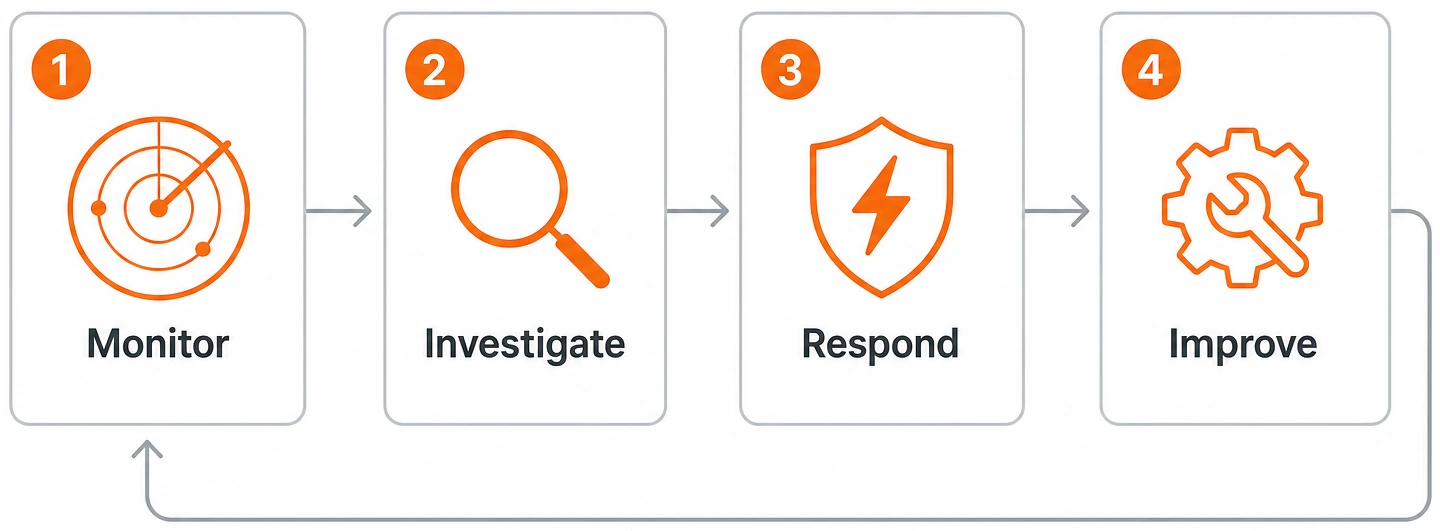
The Blue Team’s core mission is simple: keep attackers out, catch them quickly if they get in, and make the environment harder to attack the next time. Day to day, that usually includes:
 Monitoring systems, cloud services, user activity, and network traffic for suspicious behavior.
Investigating alerts to determine what is malicious, what is benign, and what needs escalation.
Responding to incidents by containing affected systems, removing threats, restoring operations, and preserving evidence when needed.
Hardening the environment through better configuration, stronger authentication, least-privilege access, and patching.
Finding and prioritizing weaknesses before attackers can exploit them.
Using threat intelligence and lessons learned from past incidents to improve rules, playbooks, and controls over time.
Example: After a phishing email slips through, the Blue Team might isolate an endpoint, review sign-in logs, reset credentials, block related indicators, tune email protections, and brief leadership on impact and next steps.

Incident responders
Contain threats, investigate root cause, coordinate recovery, and support forensics when needed.

SOC analysts
Monitor alerts, review logs, triage suspicious activity, and escalate confirmed incidents.
Common Blue Team roles
A Blue Team is rarely one person. It is usually a collection of defensive roles, and in smaller organizations one person may perform several of them.

Threat hunters
Proactively look for signs of hidden attackers using hypotheses, telemetry, and threat intelligence.

Security engineers
Build and maintain defensive controls such as firewalls, endpoint protection, email security, logging, and cloud security settings.

Vulnerability analysts
Identify weaknesses, prioritize remediation, and help reduce exposed attack paths.

Security architects
Define the long-term defensive design, standards, and control strategy for the organization.

Digital forensics
Analyze suspicious files, devices, or activity to understand what happened and improve future detection.
Blue Team vs. Red Team vs. Purple Team
Organizations often use different “team” labels to describe how they test and improve security. These teams are not opponents in a literal sense; they are different ways to simulate attacks, evaluate defenses, and turn findings into action.
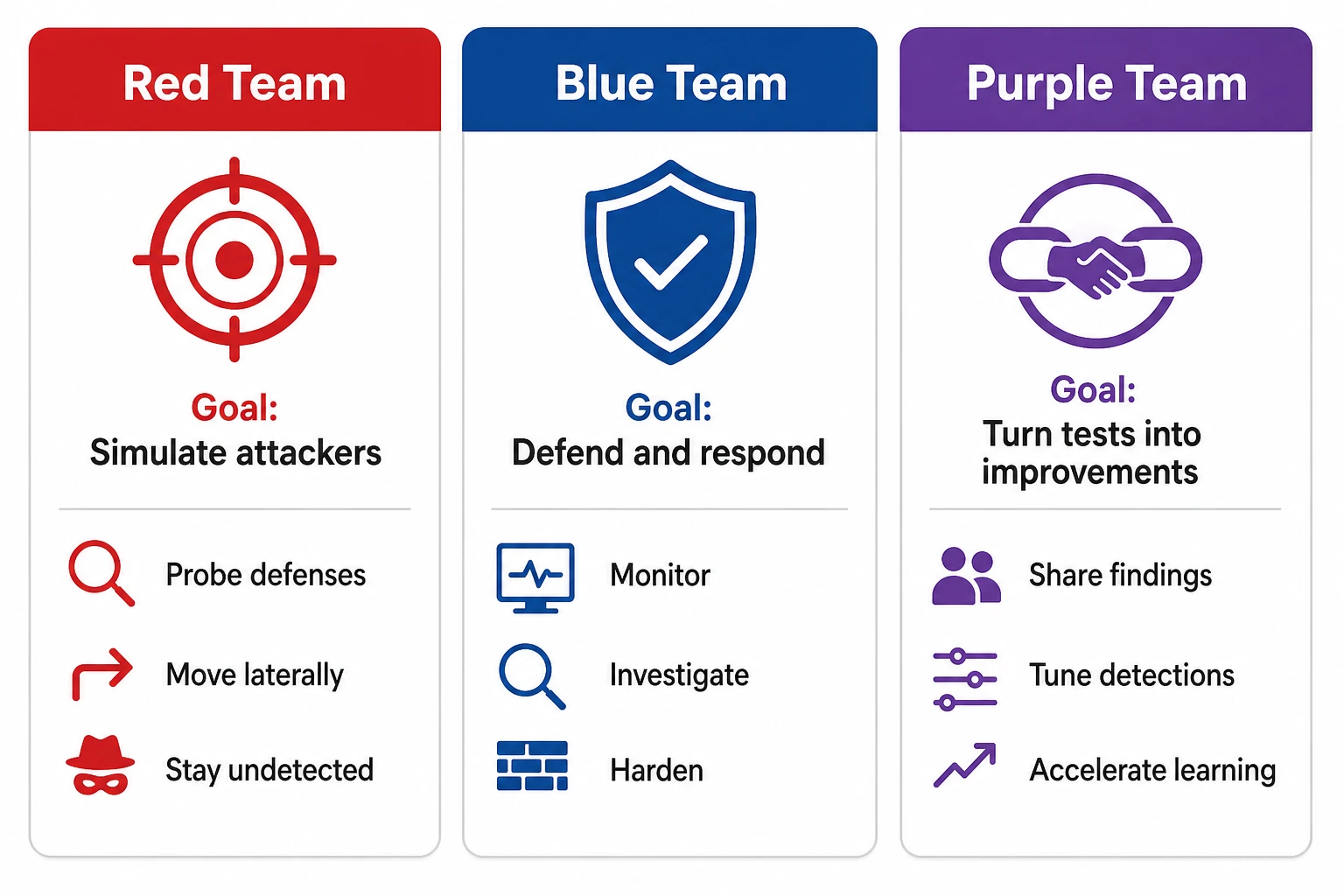
A common misconception is that the Purple Team is always a separate team. In practice, “purple teaming” is often a collaborative method: the Red Team shows what worked, the Blue Team shows what was or was not detected, and both sides improve the environment faster than they would alone.
How Blue Teams defend
Blue Teams usually work across five recurring areas of defense:
05
04
03
02
01
Monitoring
Collect and review telemetry from endpoints, servers, cloud platforms, identities, email, and networks to spot suspicious patterns such as unusual logins, unexpected data movement, or malicious process behavior.
Hardening systems
Reduce attack surface with secure baselines, multi-factor authentication, least privilege, patching, segmentation, and safer default configurations.
Testing & assessment
Run vulnerability scans, review configurations, validate controls, and use exercises or external testing to verify that defenses actually work.
Incident response
Contain the issue, investigate scope and root cause, restore systems, communicate clearly, and prevent recurrence.
Continuous improvement
Feed lessons from incidents, testing, and threat intelligence back into playbooks, training, detections, and architecture decisions.
In-house, outsourced, or hybrid?
Many organizations do not need a department literally called “Blue Team,” but they do need Blue Team capability. That capability usually shows up in one of three forms:

Outsourced (MDR / MSSP)
A managed provider runs detection and response on your behalf, 24/7, at a fraction of the cost of building it yourself.

In-house
A dedicated internal team. Highest control and context, but expensive to staff around the clock.

Hybrid
A small internal team owns context and decisions; an external partner provides 24/7 eyes-on-glass and specialist expertise.
For many small and mid-sized businesses, hybrid or outsourced models are the most practical path to 24/7 coverage. The important question is not “Do we have a Blue Team title?” but “Can we detect, respond, and improve reliably?”
Under the hood
For readers who want a slightly more technical view, effective Blue Team programs usually rely on a few patterns behind the scenes:
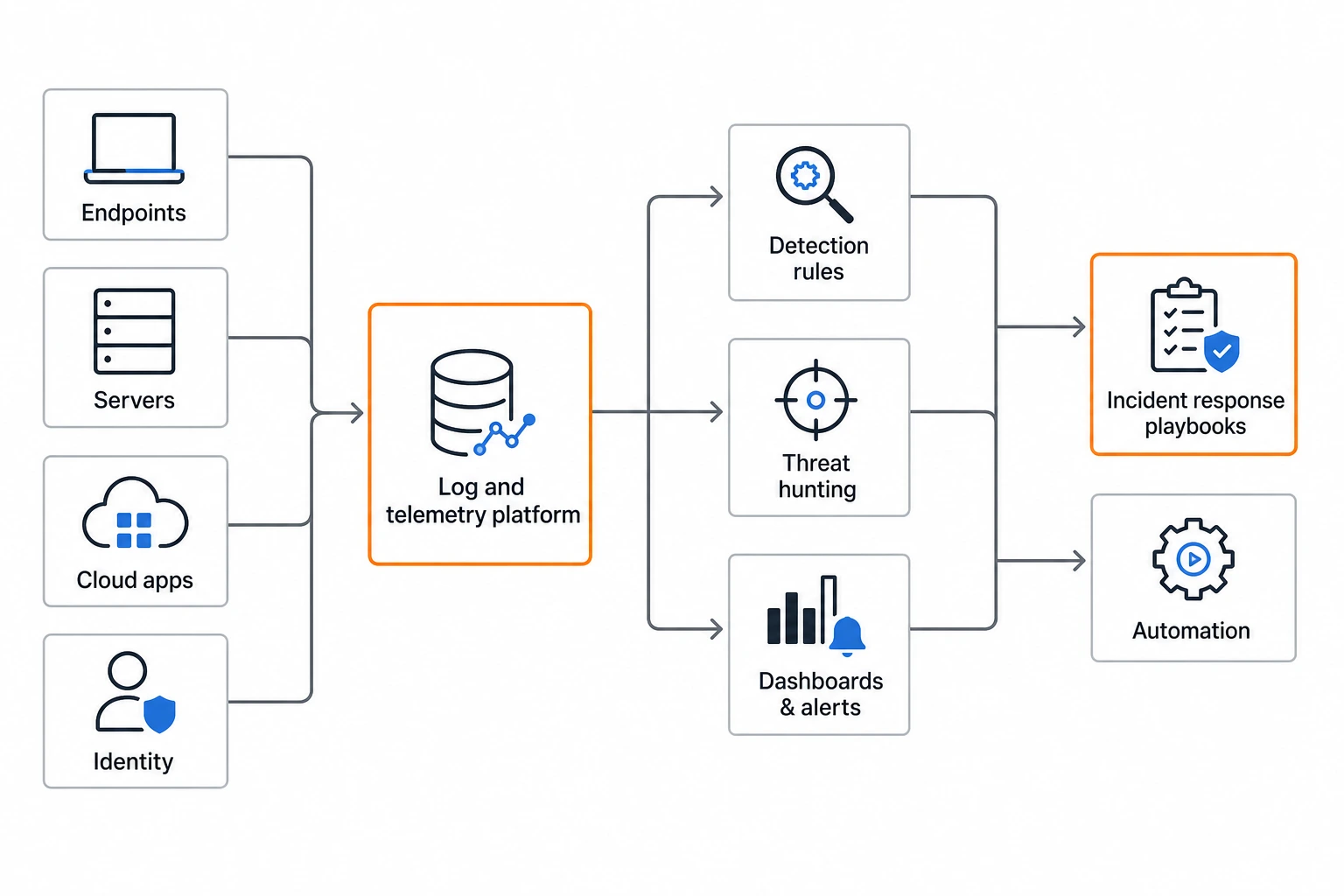
In mature programs, Blue Team work is not just about operating tools. It is a feedback loop between monitoring, engineering, testing, business communication, and architecture — all aimed at making attacks harder, noisier, and less damaging.
Why Blue Teams matter for businesses
Blue Teams matter because security is not just about prevention. Businesses also need visibility, response capability, and a repeatable way to improve after something goes wrong.

Fewer successful attacks
Strong defenses and active monitoring reduce the chance an attack lands at all.

Faster detection
Incidents are caught earlier, limiting damage, downtime, and recovery cost.

Clarity for leadership
Plain-language reporting on risks, incidents, and improvements — not jargon.
Want a bit more detail?
Optional reading for anyone who wants to go a step deeper into how Blue Teams help.
Blue Teams are often measured using a mix of operational and risk-based metrics, such as:
Mean time to detect (MTTD).
Mean time to respond or contain (MTTR).
Coverage of logging, endpoint visibility, and critical system monitoring.
Closure rate for high-risk vulnerabilities or repeat incident causes.
Quality of incident handling, reporting, and lessons learned over time.
Good measurement focuses on whether the organization is becoming harder to attack and faster to recover — not just on how many alerts were closed.
Usually, yes. IT and Blue Team responsibilities overlap, but they are not the same. IT is primarily responsible for keeping systems available and functioning; Blue Team work assumes that systems may be targeted and focuses on detection, containment, investigation, and security hardening under adversarial conditions.
A SOC (Security Operations Center) is usually the operational function that monitors alerts, investigates suspicious activity, and manages parts of incident response. The broader Blue Team includes the SOC but can also include engineers, threat hunters, architects, responders, and others responsible for defensive security across the environment.
A typical Blue Team stack often includes endpoint detection and response (EDR), centralized log collection or a SIEM, identity protection controls, vulnerability scanners, email security, case management or ticketing, and tools for threat intelligence or digital forensics.
Tools matter, but tools alone do not create a Blue Team. Skilled analysts, clear escalation paths, tested playbooks, and good communication are what turn tooling into actual defensive capability.

