
You've invested in a Virtual Private Network (VPN) to keep your remote team connected, and for a long time, that felt like enough. You followed the "best practices" of the 2010s, assuming that as long as your data stayed inside a secure tunnel, your Louisville business was safe.
The uncomfortable reality? The VPN is now one of the biggest liabilities in your network. In 2026, relying on a VPN is like building a massive wall around your office but handing a master key to every employee, and then hoping nobody loses theirs. For small to mid-sized businesses (SMBs) in industries like legal, accounting, and manufacturing, this "castle-and-moat" strategy is failing in measurable, costly ways.
The Problem: Why Your VPN Has Become a Security Liability
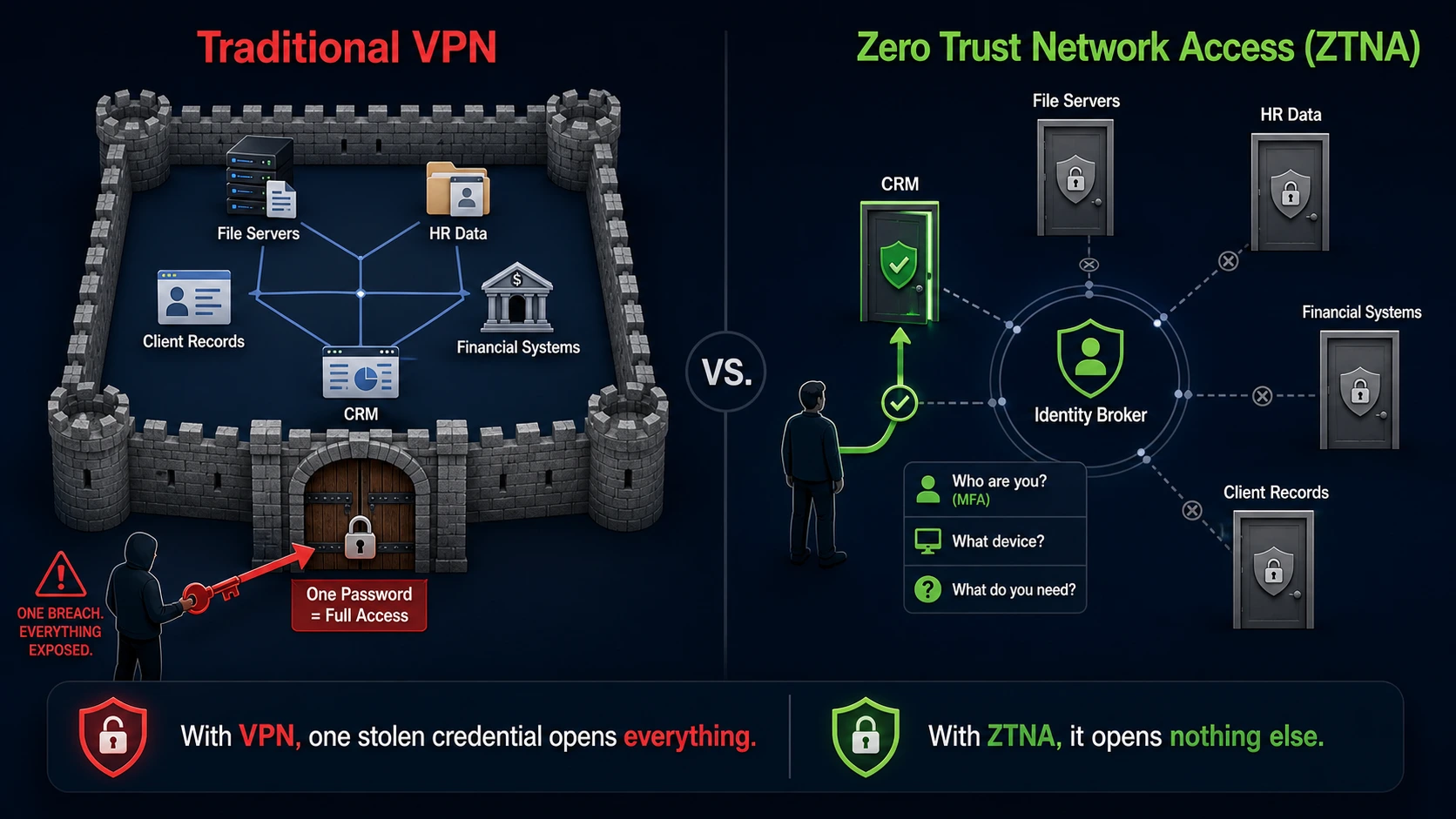
A VPN is designed to extend your office network to a remote device. Once a user logs in, the VPN typically grants them access to the entire network. Or, at least broad segments of it. This model is called implicit trust: authenticate once at the door, and you're in everywhere.
The architecture made sense in an era when all your employees, data, and applications lived inside a single building or data center. That world no longer exists. Today, your data lives in Microsoft 365, your CRM is cloud-hosted, and your team is spread across St. Matthews, Jeffersontown, Indiana, and their living rooms. Extending a flat, perimeter-based network tunnel to all of those locations creates enormous exposure. One stolen credential doesn't just compromise a laptop, it effectively places an attacker inside your server room.
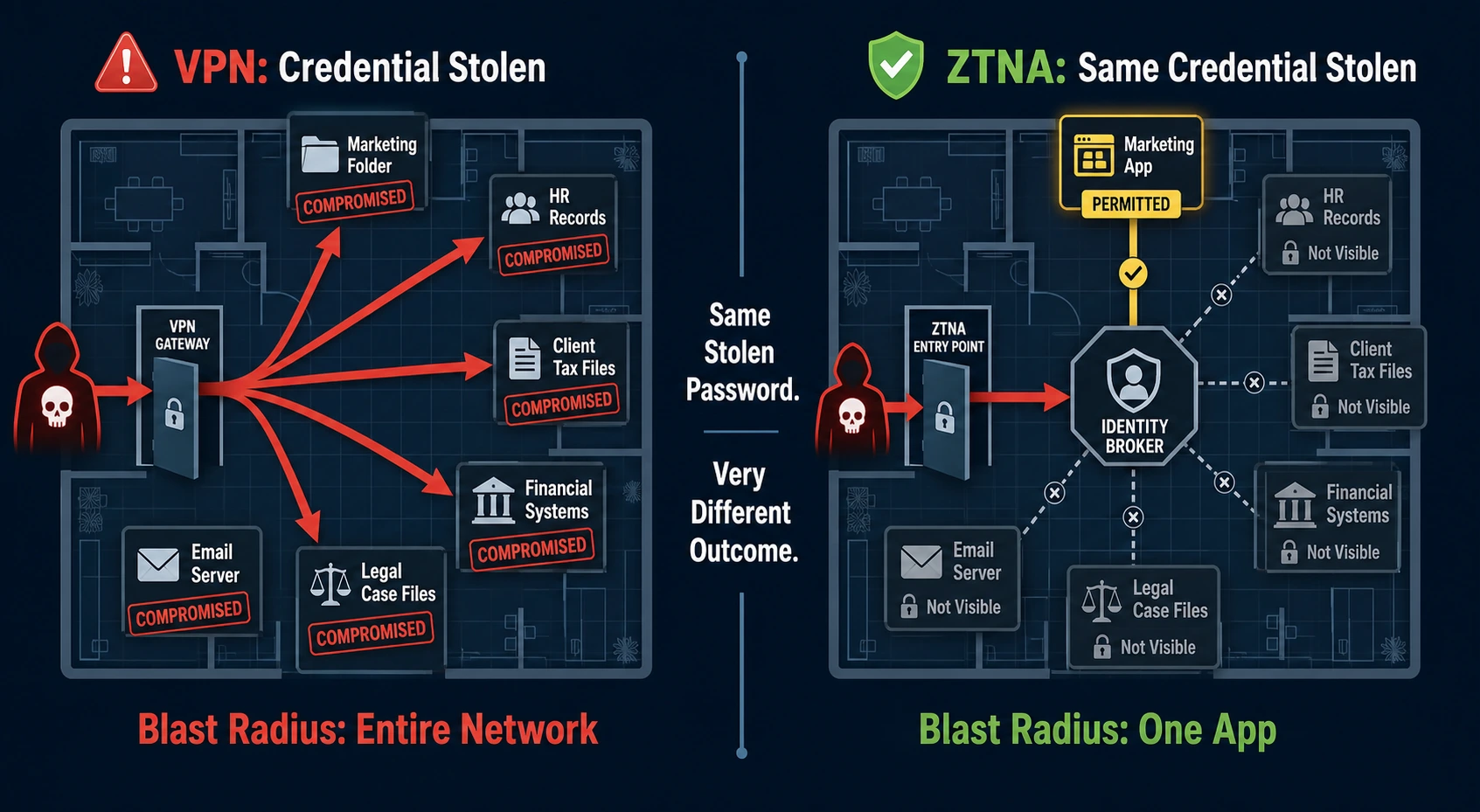
This risk is more than theoretical. Attackers now understand exactly how to exploit the VPN trust model. Once inside a VPN, they can perform lateral movement. Quietly hopping from a low-value target like a shared marketing folder to a high-value target like your client's tax records, legal case files, or financial data. The attacker doesn't need to break anything. They just need to walk.
The Evidence: VPNs Are Actively Under Attack
The data on VPN risk has become hard to ignore.
VPN CVEs are exploding. Zscaler ThreatLabz analyzed 411 VPN CVEs over five years and found an 82.5% growth in annual vulnerability volume. Roughly 60% of the most recently catalogued VPN vulnerabilities carried a high or critical CVSS score, and remote code execution (RCE) vulnerabilities were the most prevalent type. Named vendors like Ivanti, Fortinet, Cisco, and Citrix have all had major VPN vulnerabilities actively exploited. Several before patches were even available.
More than half of organizations have already been hit. Per the Zscaler 2026 VPN Risk Report, 56% of organizations reported a VPN-related security incident in the past twelve months, up significantly from prior years. That spans every sector, not just large enterprises.
Credential abuse is the top attack vector. Stolen credentials factored into more than 60% of data breaches reviewed in the 2025 Verizon Data Breach Investigations Report (DBIR), making it the most common initial access vector. For businesses whose VPN relies solely on a username and password, a single leaked credential from a phishing email or dark web combo list is all it takes. Credential stuffing (automated attacks that test stolen username/password pairs) now accounts for a median of 19% of all daily authentication attempts across organizations analyzed by Verizon, rising to 25% at enterprise-sized companies.
The "blast radius" is growing and attackers are moving faster. According to Mandiant's M-Trends 2026, the global median dwell time (the time between initial breach and detection) has risen to 14 days, up from 11 days in 2024. More alarmingly, the median time between an attacker's initial access and their hand-off to a secondary threat group, such as a ransomware gang, collapsed from more than 8 hours in 2022 to just 22 seconds in 2025. Once an attacker is inside, the clock is ticking faster than most businesses can respond.
Edge devices like VPNs are the primary entry point. The Verizon 2025 DBIR found that edge device and VPN exploitation grew from representing 3% of initial access cases to 22% in a single year. Roughly an 8x increase. The CrowdStrike 2026 Global Threat Report found that 40% of vulnerabilities exploited by China-nexus actors targeted edge devices such as VPNs, firewalls, and gateways.
The market is shifting away from VPNs rapidly. According to the 2026 Zero Trust Report, 82% of organizations now view Universal ZTNA as essential to their security strategy. However, only 17% have fully implemented it, with 46% in partial deployment and 24% planning to begin. Organizations still on traditional VPNs alone are increasingly the "low-hanging fruit" for attackers who know exactly which CVEs to target.
The Business Impact: Kentucky Laws and Financial Reality
For Louisville firms, a breach isn't just an IT headache, it's a legal and financial event that can threaten the survival of the business.
Kentucky's Data Breach Notification Law (KRS § 365.732)
Under Kentucky's data breach notification law, codified at KRS § 365.732, any business that owns or licenses the personal information of Kentucky residents must notify affected individuals "in the most expedient time possible and without unreasonable delay" after a data breach. The law applies when there is an unauthorized acquisition of unencrypted, unredacted personal data. Which is exactly the scenario a VPN-facilitated breach can create. If notification is required for more than 1,000 residents, the business must also notify nationwide consumer reporting agencies.
The Kentucky Consumer Data Protection Act (KCDPA)
The Kentucky Consumer Data Protection Act (KCDPA), codified at KRS 367.3611 to 367.3629, went into full effect on January 1, 2026. It applies to businesses that conduct business in Kentucky or target Kentucky residents and meet one of two thresholds:
Control or process personal data of at least 100,000 Kentucky consumers, or
Control or process data of at least 25,000 consumers while deriving over 50% of gross revenue from the sale of personal data
Under the KCDPA, controllers (that's you, if you're collecting client data) are required to "establish, implement, and maintain reasonable administrative, technical, and physical data security practices" to protect the confidentiality, integrity, and availability of consumer data. The law does not enumerate specific technologies. "Reasonable security" is determined by industry standards and the sensitivity of the data you hold.
If you are a law firm or accounting practice handling the sensitive financial or legal data of thousands of Kentuckians, a VPN that grants broad network access without device posture checks, continuous verification, or application-level segmentation may be a difficult standard to defend as "reasonable", especially when the security industry has broadly recognized ZTNA as the current best practice.
The Financial Stakes
The numbers on ransomware costs are sobering:
The average total cost of a ransomware incident in 2025, including downtime, recovery, and remediation, reached $5.08 million (IBM Cost of a Data Breach Report, 2025)
For SMBs with 100–250 employees, average ransomware recovery costs alone averaged $638,536, excluding any ransom payment (Sophos State of Ransomware, 2025)
The average data breach cost for businesses with fewer than 500 employees is $3.31 million (IBM)
Recovery costs for small businesses typically average $120,000, with downtime running $53,000 per hour (VikingCloud 2025)
75% of SMBs say they could not continue operating if hit with a ransomware attack (StrongDM 2025)
And those numbers don't include regulatory exposure, legal fees, or the permanent erosion of client trust that follows a public breach disclosure.
The Solution: Zero Trust Network Access (ZTNA)
If a VPN is a master key to the building, Zero Trust Network Access (ZTNA) is a security guard stationed at every single door inside the building. One who checks your ID, confirms your clearance level, and verifies you're not running a fever before you can enter each room.
ZTNA doesn't care if you are "on the network." It only cares about who you are, what device you're using, and what you're specifically allowed to access, and it keeps checking throughout your entire session.
How ZTNA Works
- Identity-First Access. Access is granted based on verified user identity, typically integrated with tools like Microsoft Entra ID (formerly Azure AD) or similar identity providers, combined with Multi-Factor Authentication (MFA). Authentication is not a one-time event; it's continuous.
- Device Health Verification. If an employee tries to connect from a compromised device, a machine with an outdated OS, or one that lacks encrypted storage, ZTNA can block the connection automatically. Unlike VPN, which has no awareness of device state, ZTNA continuously integrates device compliance into access decisions.
- Application-Level Access, Not Network Access. This is the critical architectural difference. Instead of being handed the keys to the entire network, the user is granted access only to the specific application they need at that moment (the billing software, the CRM, a specific document repository) and nothing else is visible to them. There's no network-level presence, which means there's nothing to move laterally through if their credentials are ever compromised.
- Reduced Attack Surface. Because applications are hidden behind ZTNA brokers and never directly exposed to the internet, they become invisible to attackers scanning for vulnerable endpoints. No exposed concentrator, no public-facing VPN gateway to probe for zero-days.
- Session-Level Revocation. If anomalous behavior is detected mid-session (a user suddenly attempting to access an unusual resource, or a device's security posture dropping) access can be revoked instantly without waiting for the session to expire.
VPN vs. ZTNA: A Side-by-Side Comparison
| Feature | Traditional VPN | ZTNA |
|---|---|---|
| Trust model | Implicit trust after login | Never trust, always verify |
| Access scope | Broad network access | Application-level only |
| Device awareness | None | Continuous device posture checks |
| Lateral movement risk | High — attacker can roam the network | Eliminated — no network presence granted |
| Credential theft impact | Catastrophic (full network access) | Contained (access limited to permitted apps) |
| Infrastructure exposure | VPN gateway publicly visible | Applications hidden; no exposed concentrator |
| Continuous verification | No — authenticate once, trust indefinitely | Yes — continuously re-verified |
| Scalability | Requires capacity planning and hardware | Cloud-delivered, scales automatically |
| Alignment with KCDPA "reasonable security" | Increasingly difficult to justify | Aligns with current industry best practice |
At Argus, we focus on Cybersecurity that simplifies your life. Transitioning to ZTNA means you no longer have to manage complex network segments. You manage identities. This is especially critical for our clients in Legal Services and Accounting, where protecting client confidentiality isn't just a best practice. It's an ethical and regulatory obligation.
Actionable Checklist: Moving from VPN Risk to Zero Trust
If you're still running a traditional VPN as your primary remote access method, here is a practical path forward:
Audit Your Access. List every application your remote team accesses. Does every employee actually need access to the entire file server, or do they really just need three specific applications? The answer to that question reveals how much unnecessary exposure you're carrying right now.
Implement MFA Everywhere. No Exceptions. Every remote connection must require a secondary verification factor before access is granted. A VPN without MFA is a single-point-of-failure waiting to be exploited. Stolen credentials are the top breach vector for a reason.
Verify Device Posture. Set policies that block connections from devices without current antivirus, operating system patches, or full-disk encryption. A clean credential on a compromised device is still a breach waiting to happen.
Review Your Kentucky Compliance Posture. Audit your remote access methods against the KCDPA's "reasonable security" standard (KRS 367.3611–367.3629) and KRS § 365.732 breach notification obligations. If a breach occurred today, would your current controls hold up to scrutiny? You can explore compliance terminology further in our CyberPedia.
Plan a Phased ZTNA Migration. ZTNA doesn't have to be an all-or-nothing overnight replacement. A phased rollout typically starts with your highest-risk applications (financial systems, client data repositories) and extends from there. You don't have to disrupt daily operations to do this right.
Consult a vCIO. Use vCIO Services to build a roadmap that transitions your team from legacy VPN to a ZTNA architecture with a realistic timeline, budget, and minimal operational disruption.
The Argus Advantage
"Zero Trust" can sound like vendor marketing jargon. It isn't. It's a specific, well-defined architectural model that addresses the precise weaknesses attackers are exploiting today. What it means in practice is that even if an attacker steals one of your employee's passwords, the damage they can do is contained to that person's specific application permissions, and not your entire network.
At Argus, we take a plain-English approach to all of it. We're not here to sell you a product and disappear. Whether you're a manufacturing plant in Jeffersontown or a law office downtown, we act as a true security partner, providing proactive monitoring and rapid response to keep your team productive and your clients' data protected.
In a world where your network perimeter has vanished, your identity is the only firewall that matters. Don't let a legacy VPN be the weak link that costs your business everything.