
You've spent years building your manufacturing operation here in Louisville; refining your floor processes and ensuring your team hits its production quotas. But while you've mastered the physical machinery of your shop, there's a digital engine running behind the scenes, your network, that might be closer to a breakdown than you realize.
The uncomfortable reality is that the very connectivity making your plant more efficient is also making it a massive target. In the time it takes for a shift change at the Ford Truck Plant, a single unpatched vulnerability in your network could bring your entire production line to a screeching halt.
The Targeted Industry: Why Manufacturing Is in the Crosshairs
Manufacturing is no longer just about moving parts. It's about moving data. Unfortunately, cybercriminals have noticed in a big way.
According to the IBM X-Force 2026 Threat Intelligence Index, manufacturing was the most-attacked sector in 2025, accounting for 27.7% of all cyberattacks globally, the highest share ever recorded, and the fifth consecutive year the industry has held that unwanted top spot. No other industry comes close.
Why? Because hackers know that for a manufacturer, downtime isn't just an inconvenience, it's a financial catastrophe. They bank on the fact that you'll pay a ransom just to get the machines moving again. Attacks on manufacturers typically target two things: extortion (forcing a ransom payment) and intellectual property theft (stealing your proprietary processes and designs).
What the Data Says: How These Attacks Happen
The Verizon 2026 Data Breach Investigations Report (DBIR), which analyzed over 22,000 confirmed breaches across 145 countries, paints a clear picture of how manufacturers get hit:
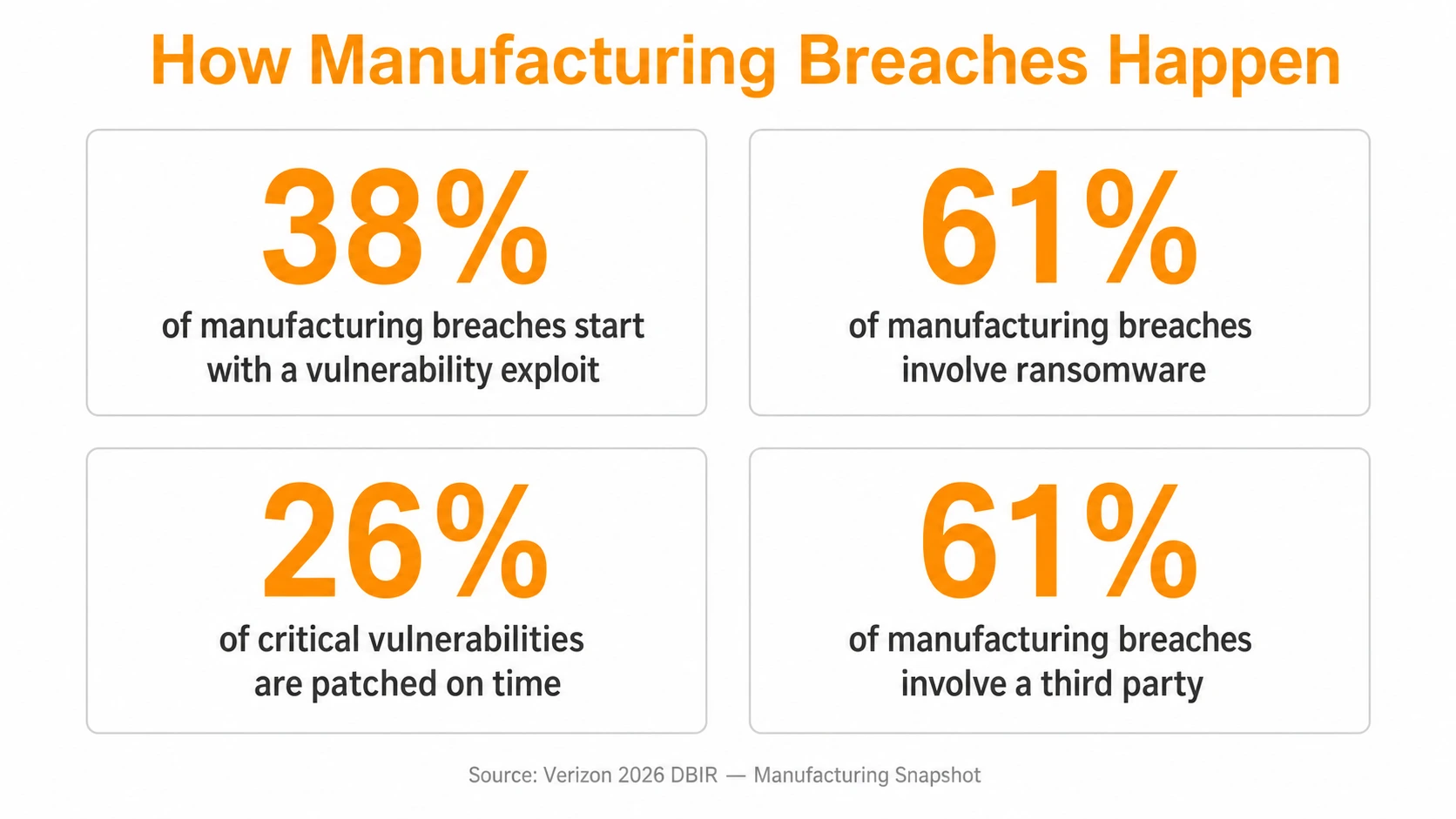
Vulnerability exploitation is the #1 initial access vector in manufacturing, involved in 38% of manufacturing breaches, even higher than the already alarming cross-industry rate of 31%. Hackers aren't waiting for you to click a bad link; they're walking through unlocked digital doors.
Despite this risk, only 26% of critical vulnerabilities (those listed in the CISA Known Exploited Vulnerabilities catalog) were fully remediated in 2025, down from 38% the year before, and the median time to full remediation increased to 43 days. The median organization also had 50% more critical vulnerabilities to patch this year than last.
Once attackers are inside, ransomware was involved in 61% of all manufacturing breaches, with malware present in 75% of incidents overall.
Third-party involvement reached 61% of manufacturing breaches. Meaning a vendor, contractor, or software provider was the entry point in nearly two out of three cases.
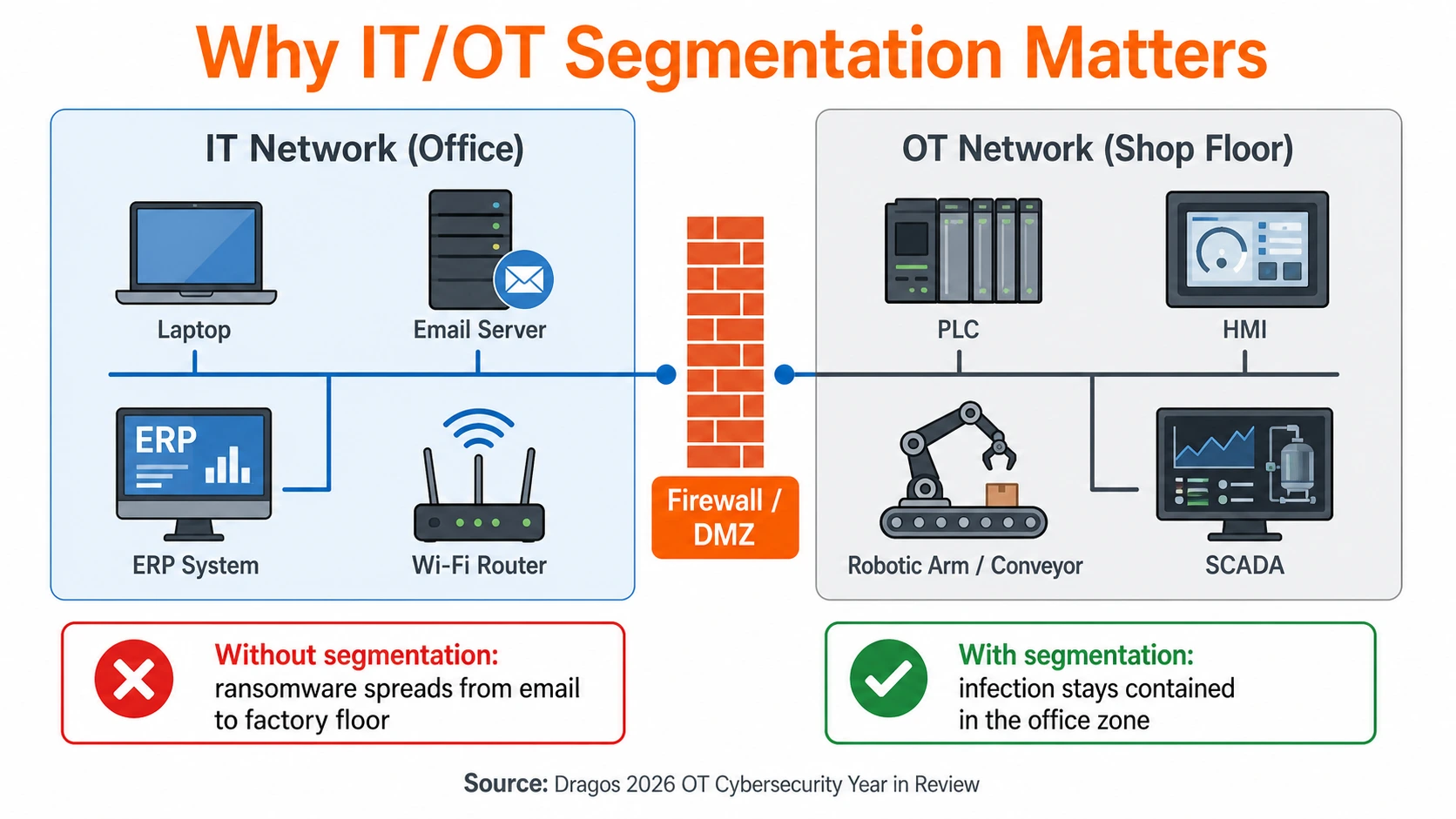
Furthermore, research from Dragos's 2026 OT Cybersecurity Year in Review reveals that 88% of Operational Technology (OT) networks struggle with detection and response. OT networks are the systems that actually run your shop floor equipment, your PLCs, HMIs, SCADA systems, and robotic arms. The Dragos data also shows that 3,300 industrial organizations were impacted by tracked threat groups in 2025, with a median 42-day dwell time for OT ransomware before it was detected. In practical terms: if someone is already inside your OT environment, you likely won't know until a machine stops.
The Business Impact: More Than Just "IT Issues"
When we talk about manufacturing IT support in Louisville, we aren't just talking about fixing a slow email server. We are talking about the survival of your business. A weak network leads to three major business risks:
1. Production Downtime
In a "Just-in-Time" manufacturing environment, a four-hour outage can ripple through your entire supply chain. If your ERP system is locked by ransomware, you can't track inventory, you can't ship product, and you can't get paid. A real-world example: a late-2025 ransomware attack on Asahi Group Holdings forced a shutdown of their domestic manufacturing facilities and a suspension of shipments, while also compromising corporate data.
2. Intellectual Property (IP) Theft
Whether you are distilling bourbon or machining aerospace parts, your proprietary processes and designs are your "secret sauce." A network breach can result in your blueprints being sold to competitors overseas before you even realize they were stolen. IBM X-Force found that data theft targeting intellectual property was one of the two primary attack outcomes for manufacturers in 2025.
3. Insurance and Legal Liability
Cyber insurance providers are becoming increasingly strict. If you cannot demonstrate that you've performed regular network security audits and maintain controls like MFA, they may deny your claim after a breach. Kentucky law, covered in detail below, also carries growing obligations for manufacturers that handle employee and vendor data.
What Is a Network Security Audit? (In Plain English)
Think of a network security audit as a "preventative maintenance" check for your digital infrastructure. Just as you wouldn't run a multi-million dollar CNC machine for years without checking the fluids and sensors, you shouldn't run a business network without a deep-dive inspection.
At Argus Cybersecurity and Support, we look at your network through two lenses:
The Perimeter: Are the "doors and windows" (firewalls, VPNs, and logins) locked?
The Interior: If someone gets inside, can they jump from your office computer to your plant floor controllers?
The goal is to identify vulnerabilities, digital cracks in your armor, before a hacker uses them to install ransomware or steal your IP. A professional audit produces a prioritized action plan, not a 50-page report of technical jargon.
Your Manufacturing Network Audit Checklist
If you haven't had a professional audit in the last 12 months, your risk level is likely in the red zone. Use this checklist to evaluate where you stand today:
Segment the OT Network: Is your plant floor equipment (PLCs, HMIs, SCADA systems) on the same network as the office staff's Wi-Fi? They must be separated. Dragos found that 56% of OT networks cannot see below the IT/OT boundary. Meaning a ransomware infection on a front-office PC can move freely to shop floor equipment in these environments.
Audit Remote Access: Do outside vendors or contractors have "always-on" access to your systems? This is a major entry point. In the 2026 DBIR, 61% of manufacturing breaches involved a third party. Remote access should be granted only when needed, monitored, and protected by Multi-Factor Authentication (MFA). Notably, only 23% of third-party organizations fully remediated missing or misconfigured MFA on their cloud accounts.
Inventory All Assets: You cannot protect what you don't know exists. A proper audit identifies every tablet, sensor, PLC, and server connected to your network. Attackers use tools like Shodan to find your exposed devices even if you don't know they're there.
Vulnerability Scanning & Prioritized Patching: Run automated tools to find unpatched software. With 38% of manufacturing breaches starting with a vulnerability exploit, timely patching is non-negotiable. Focus first on CISA Known Exploited Vulnerabilities, and patch them within 7 days wherever operationally possible.
Review Backup Integrity: Are your backups "air-gapped" (disconnected) from the main network, and are they tested regularly? If your backups are connected, ransomware will encrypt them too, leaving you with zero recovery options. The DBIR found that 69% of ransomware victims in 2025 refused to pay the ransom, but that's only possible if your backups are intact and verified.
Test Your Incident Response Plan: With a 42-day median OT dwell time, the question isn't just "can we prevent an attack?" It's "do we know what to do when it happens?" Tabletop exercises should be OT-specific, not just IT-focused.
Kentucky Compliance: KRS 365.732 and the New KCDPA
Many Louisville manufacturers assume they don't have to worry about data privacy laws because they don't sell directly to consumers. This is an increasingly dangerous assumption, especially since the start of 2026.
KRS 365.732: Data Breach Notification
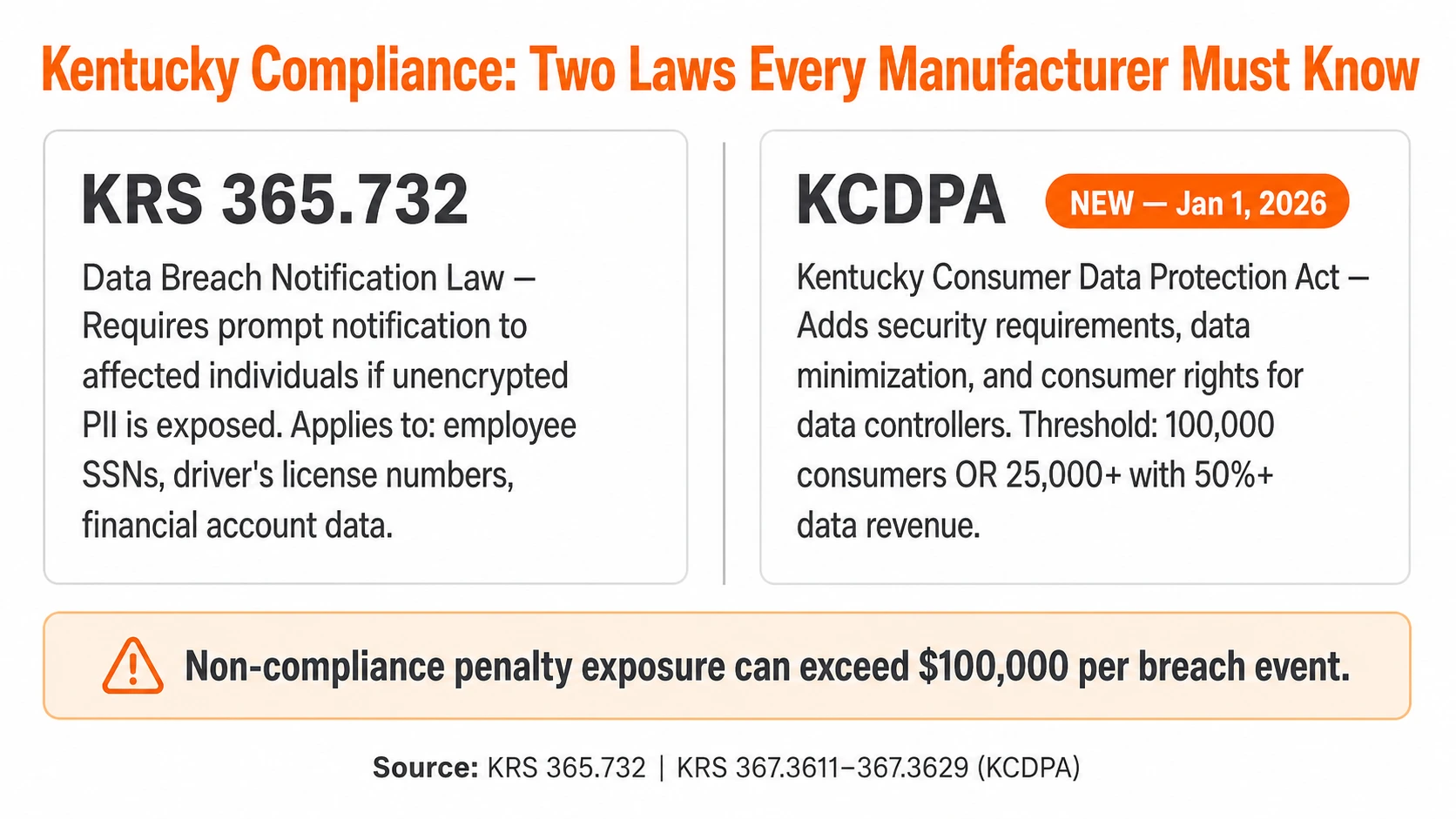
KRS 365.732 is Kentucky's data breach notification statute. It requires any entity that handles computerized personal information (PII) of Kentucky residents to notify affected individuals without unreasonable delay if their unencrypted data is accessed by an unauthorized person. Kentucky does not set a fixed number of days. Regulators interpret "without unreasonable delay" as days to weeks, not months, and organizations operating across multiple states should align to the strictest applicable clock (as short as 30 days in states like California, Florida, and Colorado).
What counts as PII for a manufacturer?
Employee Social Security numbers in your HR or payroll system
Driver's license numbers for your logistics team
Financial account information for your local suppliers and vendors
The KCDPA: Kentucky's New Comprehensive Privacy Law (Effective January 1, 2026)
What many manufacturers don't yet know is that Kentucky's new Kentucky Consumer Data Protection Act (KCDPA) took effect on January 1, 2026, and it goes significantly further than KRS 365.732. The KCDPA establishes new security obligations, data minimization requirements, and consumer rights for residents whose data you hold.
Your business generally falls in scope if, during a calendar year, you control or process personal data of at least 100,000 Kentucky consumers, or 25,000 consumers where more than 50% of gross revenue comes from data sales. For many mid-sized manufacturers, with employees, vendors, and logistics partners across the state, the 100,000-consumer threshold may be closer than you think when HR, payroll, and supply chain data are combined.
A proactive manufacturing cybersecurity strategy in Louisville that includes regular audits and documented security controls is the most defensible position under both statutes. If your network is breached and unencrypted PII is stolen, notification costs, legal fees, and potential enforcement actions under both laws can easily exceed $100,000.
Frequently Asked Questions About Manufacturing IT
How long does a network security audit take?
Typically, a comprehensive audit for a mid-sized manufacturing plant takes between 1 to 2 weeks, depending on the complexity of your OT environment.
Will an audit disrupt my production?
No. A professional audit is designed to be non-intrusive. Passive scanning techniques observe your network traffic without slowing down your machinery.
What is the "CyberPedia"?
It's our local resource for Kentucky business owners to learn about threats in plain English. You can check it out at argusprotects.com/cyberpedia.
What is the difference between IT and OT security?
Your IT network handles business data: Email, ERP, accounting. Your OT network controls physical equipment: Conveyor belts, robotic arms, PLCs. Historically kept separate, these networks are increasingly connected, which is why 88% of OT environments now struggle with detection and response. A proper audit evaluates both layers.
How Argus Can Help
We specialize in managed IT services in Louisville, specifically tailored for the high-uptime needs of the manufacturing sector. We don't just give you a report. We give you a prioritized action plan to secure your shop floor and your data, delivered in plain language your operations team can act on.
Whether you need a one-time audit or a vCIO (virtual Chief Information Officer) to manage your long-term technology roadmap, our people-first approach ensures your IT works for your production goals, not against them.